Artificial intelligence is no longer a future concept. It is already changing how lawyers research, draft, analyse information, and deliver legal services. As AI tools become more widely available, legal professionals increasingly need to understand not only what these technologies can do, but also how to use them responsibly and effectively.
A4ID is partnering with the Continuing Legal Education Institute in Pakistan and the Pakistan Bar to deliver a virtual training programme to provide a practical introduction to AI for lawyers, helping participants build confidence with emerging technologies and understand their impact on the future of legal practice
Scheduled for December – register your interest now!
Programme Overview
Virtual national training series for lawyers across Pakistan
Sessions delivered by leading UK-based law firms and legal professionals
Interactive format with practical examples and discussion-based learning
Fully funded – no cost to participants
Gain Practical Skills for Modern Legal Practice
Designed for lawyers with little or no prior experience of AI, this interactive programme moves beyond theory to focus on practical applications. Participants will explore widely used AI tools, including large language models such as ChatGPT, Claude, and Gemini, and learn how they can support legal research, drafting, document review, and case preparation. Through real-world examples and demonstrations, participants will discover how AI can help improve efficiency while maintaining the critical legal judgment that clients and courts rely upon.
Learn How to Use AI Responsibly
While AI offers significant opportunities, it also presents important risks. The programme will help participants understand the potential limitations of AI systems, including issues relating to accuracy, reliability, confidentiality, and bias. Lawyers will gain practical guidance on how to assess AI-generated outputs, avoid common pitfalls, and ensure that the use of AI remains consistent with professional and ethical obligations.
Global Perspectives, Local Relevance
The programme brings together international and Pakistani legal professionals to provide a balanced and practical learning experience. Participants will benefit from the insights of lawyers with experience in legal innovation and AI adoption in international practice, alongside local experts who can contextualise these developments within Pakistan’s legal and regulatory environment. This combination of expertise ensures that discussions remain relevant, realistic, and applicable to everyday legal work.
Interactive and Practical Learning
Each session will combine expert-led presentations with practical demonstrations, discussions, and opportunities for questions and engagement. Participants will explore real-life scenarios, examine examples of effective prompting techniques, and discuss the challenges and opportunities that AI creates for legal professionals.
Who Should Apply?
Practising lawyers and legal professionals seeking to understand and apply AI in their work.
International Partnership Enables Province-Wide Expansion of District Peace Committees Across Sindh
A community-led peacebuilding model, strengthened through UK-Pakistan legal collaboration, moves towards provincial institutionalisation, with potential to support conflict prevention, counter violent extremism and address violence against women across Sindh.
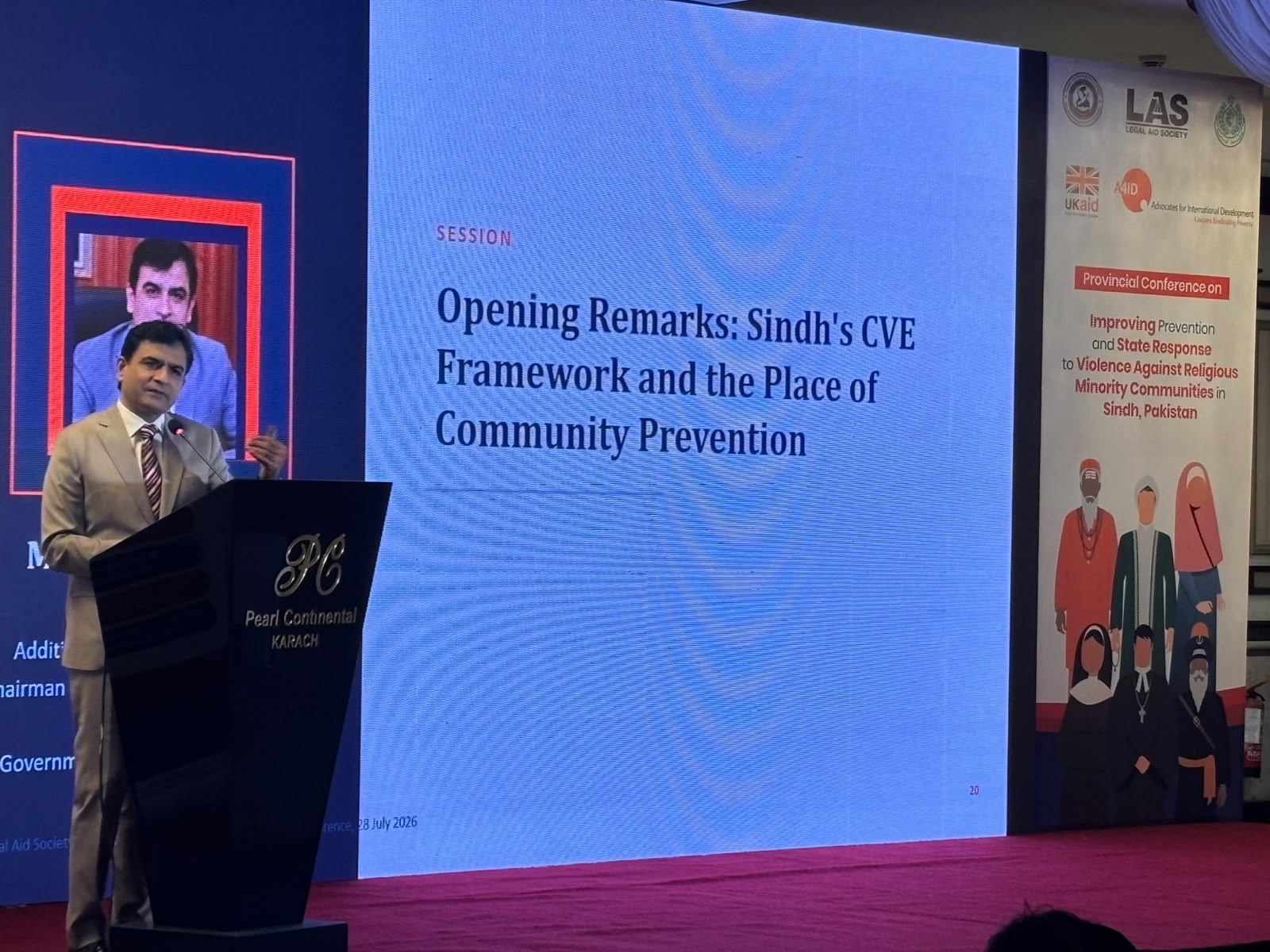
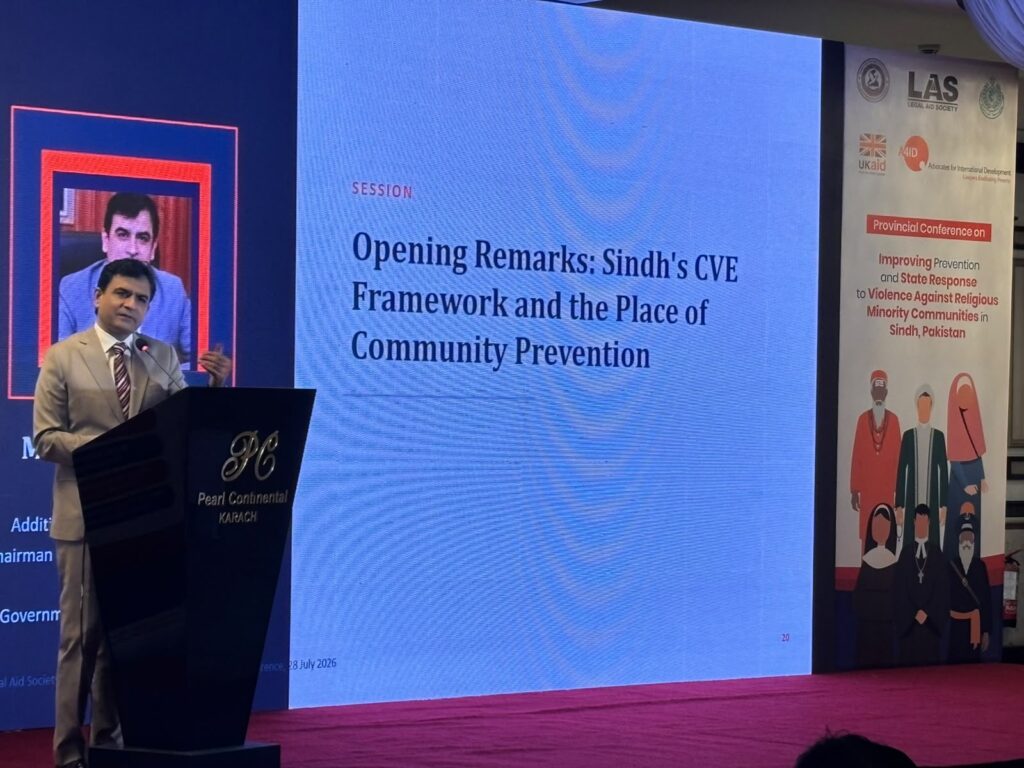
Advocates for International Development (A4ID) has welcomed a significant milestone in Pakistan, where the Government of Sindh has committed to making the District Peace Committee model a province-wide approach, marking an important step towards institutionalising community-led mechanisms for peacebuilding and conflict prevention.
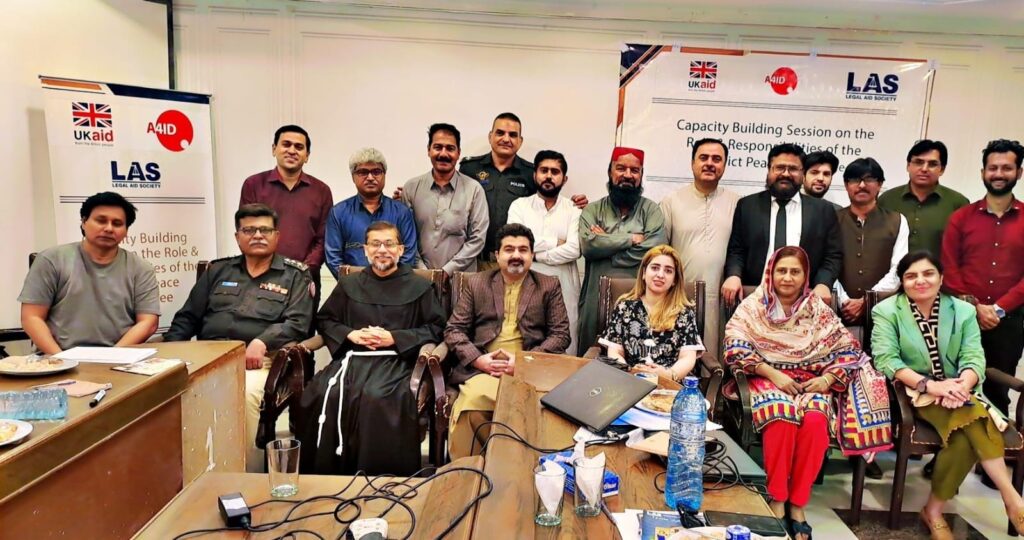
The expansion follows the operationalisation of District Peace Committees in four districts of Sindh, supported through targeted training and the development and adoption of new Standard Operating Procedures (SOPs) by the Legal Aid Society (LAS), with specialist legal expertise from the UK facilitated through A4ID.
District Peace Committees are community-based peacebuilding and conflict-prevention mechanisms that bring together representatives from different faiths, communities and local institutions. They provide a forum to identify emerging tensions, encourage dialogue and support peaceful, locally led solutions to disputes. By creating mechanisms through which concerns can be addressed before they escalate, the model supports stronger relationships between communities and contributes to more inclusive and peaceful local environments.
A significant development is that the SOPs have now been adopted within Sindh’s Countering Violent Extremism (CVE) framework. This extends their relevance beyond freedom of religion or belief (FoRB) cases, providing a framework that can contribute to wider efforts to prevent violent extremism and address violence, including violence against women.
The development therefore represents more than the expansion of an individual mechanism. It provides an opportunity to embed a community-led approach to prevention and peacebuilding within provincial systems, while retaining its grounding in local communities and institutions.
From local practice to provincial institutionalisation
The adoption of the SOPs is an important step towards taking a model that has been operationalised in four districts and establishing a consistent framework for its implementation across Sindh.
The SOPs provide practical guidance for District Peace Committees and create a basis for their wider application within the provincial CVE framework. Their adoption provides an opportunity to strengthen institutional capacity and support a more consistent approach to community-level peacebuilding and conflict prevention across the province.
The wider significance of the model lies in its potential to bring together community representatives and local institutions to address tensions and disputes through dialogue and mediation, while also contributing to broader efforts to prevent violent extremism.
Its application within the CVE framework also creates scope for the approach to contribute to efforts to address violence against women, demonstrating how community-based mechanisms can have relevance beyond their initial focus on FoRB-related concerns.
Turning legal expertise into practical impact
The work builds on A4ID’s long-standing support for the Legal Aid Society through the UK Government’s ROLE UK Programme, connecting LAS with UK legal experts to develop practical legal guidance that can be implemented by government and communities.
The partnership brings together two complementary forms of expertise: the specialist legal knowledge of UK lawyers and the Legal Aid Society’s understanding of Pakistan’s legal, institutional and community context.
This combination has enabled legal expertise to be translated into practical tools designed for use in the local context, with the potential to be adopted and applied at a much broader scale.
For A4ID, this is at the heart of the value of mobilising legal expertise for international development: not simply providing advice but working with local partners to help create approaches that can strengthen institutions and contribute to lasting change.
Strengthening freedom of religion or belief and wider prevention
Freedom of religion or belief remains an important dimension of the District Peace Committee model. Bringing different faith and community representatives together creates space for dialogue, the identification of tensions and the peaceful resolution of disputes.
The adoption of the SOPs within Sindh’s CVE framework demonstrates the broader relevance of this approach. It creates a framework through which community-led peacebuilding can contribute to wider efforts to prevent violent extremism, while also providing scope to address other forms of violence and vulnerability, including violence against women.
The model therefore illustrates how strengthening inclusive, community-level mechanisms can support both the protection of rights and wider approaches to building peaceful and resilient communities.
A milestone for international collaboration
The expansion of the District Peace Committee model demonstrates the potential of international legal collaboration when it is rooted in local expertise, partnerships and ownership.
Rather than seeking to impose an external solution, the partnership has supported the development and operationalisation of practical guidance grounded in the local context, and its subsequent adoption within a provincial government framework.
It also demonstrates the wider contribution that legal expertise can make to the Sustainable Development Goals, (SDG 16) particularly through stronger institutions, inclusive governance, access to justice and the protection of rights.
Commenting on the milestone, A4ID CEO Yasmin Batliwala MBE, Hon LLD, said: “The significance of this achievement lies not simply in the expansion of District Peace Committees, but in what it demonstrates about the power of legal expertise to turn locally rooted ideas into sustainable institutional change. Through our partnership with the Legal Aid Society, UK legal expertise has been brought together with deep local knowledge to develop practical tools that can now support a model with province-wide potential. This is what meaningful international collaboration should achieve: not solutions imposed from outside, but local capacity strengthened, systems made more effective, and communities better equipped to prevent conflict and protect rights. It is a powerful demonstration that when the law is placed in the service of people and combined with trusted local leadership, it can become a force not only for justice, but for prevention, peace and lasting change.”
As the model moves towards expansion across Sindh, A4ID looks forward to continuing its partnership with the Legal Aid Society and supporting efforts to strengthen inclusive, community-led approaches to justice, conflict prevention and peacebuilding.
The milestone is a powerful example of how legal expertise, when combined with local knowledge and trusted partnerships, can move from advice to action, and from individual interventions towards lasting institutional change.
The importance of technology and innovation has become increasingly apparent in building back better after the COVID-19 pandemic and doing so in a manner that overcomes the binary between the economy and the environment. Environmentally sustainable means of production, as embodied by the SDGs, can pave the way for new and improved industries and infrastructures, better able to accommodate today’s generation and those still yet to come.
However, innovation requires a delicate balance of proactive policies, permissive laws and incentives, and legal and regulatory frameworks that can guarantee certainty, predictability, and transparency within commercial markets to invigorate healthy competition. In order to create an environment conducive to new ideas and solutions, the law is a bedrock upon which the industry relies to be able to take on greater risk and push imaginative boundaries in realising the future we want.
Twenty Years of A4ID
A4ID’s CEO Yasmin Batliwala MBE, Hon LLD, reflects on twenty years of purpose, partnership and the power of law
A4ID exists because, after the 2004 Indian Ocean tsunami, a group of lawyers from both sides of the Atlantic, looked at the scale of what had happened and could not accept that the only thing they had to offer was a donation. They had a profession full of skill, access and influence, yet much of it was sitting unused in the face of a disaster of that scale.
On 16 August 2006, that discomfort became Advocates for International Development – A4ID, an answer to a very specific question: What if the legal profession put its power more deliberately in the service of justice?
Twenty years later, I have spent more than sixteen of them leading this organisation, and I still find that question open. Not because we have not answered parts of it. We have, but because the work of justice is never finished. There is always another institution that needs strengthening, another community that needs a seat at a table from which it has been excluded, another young lawyer working out what their career is actually for.
So, this anniversary is not a finish line for me. It is a foundation I am standing on, looking at what is still ahead.
It began with a belief
A4ID was built on the conviction that the legal profession held something extraordinary and mostly untapped: not just knowledge, but relationships, influence and credibility. These could be turned towards some of the world’s hardest problems if someone built the bridge to do it.
There was a second belief behind the first: that people working for justice and development should not have to navigate the legal world alone, and that lawyers should not have to choose between doing well and doing good. A young lawyer should be able to see purpose not as something bolted onto a career, but as part of what the career is.
That is still what we are building towards. It has not changed, even as almost everything around it has.
Twenty years, and not enough of them
I did not know, when I took this on, where it would lead, the people I would meet, the setbacks that would test my patience with the pace of change, or the wins that would arrive quietly, without anyone outside the room ever knowing they happened.
What sixteen years have taught me is that this work resists the tidy arc of an anniversary speech. Progress in access to justice is rarely a straight line. Institutions fail. Good intentions, on their own, are never enough. I have watched partnerships stall, funding dry up mid-programme, communities lose faith in processes that moved too slowly to matter to them. None of that diminishes what has been achieved over twenty years. It is part of the reality of trying to create lasting change.
We have not arrived anywhere final. We have built something worth building on.
The real story is people, not numbers
Anniversaries pull organisations towards numbers: countries, partners, lawyers mobilised, hours given pro bono. Those numbers exist, and they matter as evidence of scale. But they have never been the reason I do this work, and they are not the story I want to tell here.
The story is smaller than that, and more specific. It is a community organisation that finally had a lawyer in the room who was on its side. It is a lawyer who came to us expecting a CV line and left with a different sense of what their skills were for. It is a development leader who had been offered plenty of “advice” over the years and, for once, found someone willing to listen before reaching for the legal answer. These moments do not make headlines. I do not think they are supposed to. But they are the measure of this work I have come to trust most, because impact is often not one dramatic event.
It is a chain of moments, connected by people who refuse to accept that things must remain as they are.
Partnership is not a transaction
If there is one thing sixteen years has hammered into me, it is that nobody does this alone, and pretending otherwise is how organisations start believing their own press.
Climate justice, human rights, access to justice, accountable institutions, these are not separate problems that happen to overlap. They are deeply connected problems, too often approached from separate rooms.
A4ID’s job has often been to stand in the doorway between those rooms and make the introduction: the legal profession and civil society, expertise and need, established institutions and the people trying to gain access to them. The partnerships that last are the ones built on trust and a willingness to be told we are wrong, and a recognition that the people closest to a problem are usually closer to the solution than we are.
The law is powerful. But it is only ever as powerful as the people willing to put it to use, and the people willing to be honest about where it falls short.
What lawyers actually have to offer
I have spent most of my working life around lawyers, and I no longer think their most valuable asset is legal knowledge alone. It is what happens when that knowledge is joined to purpose: the ability to analyse complexity, navigate systems, challenge assumptions and hold institutions to account in the service of something that matters. That capacity works in a courtroom. It can be just as powerful in a community. A4ID has never been about providing pro bono hours. The question behind it has always been bigger: What happens if the legal profession fully understands the difference it is capable of making?
I do not think we are close to a full answer yet, and perhaps that is a good thing, because an unanswered question can keep an organisation curious.
A different world, the same purpose
2026 does not look like 2006. Technology has reshaped how this work gets done. Climate change stopped being a forecast and became a fact people are living through. Conflict, displacement and inequality are testing institutions that were already fragile, and I no longer take it for granted that people trust the systems meant to protect them. And don’t even get me started on what’s happening to the rule of law.
The implications are profound.
When technology changes faster than law, who protects rights? When institutions weaken, who safeguards accountability? When climate change creates new forms of vulnerability, who ensures that justice keeps pace? When inequality determines who can access power, knowledge and representation, what does meaningful equality actually require?
These are not questions for lawyers alone, but lawyers have an essential role in answering them.
I also see reasons for optimism. I watch civil society leaders build extraordinary things from the ground up, often with very little. I watch young people refuse to accept that the world has to stay as it is. I know the importance for lawyers to ask harder, more uncomfortable questions about what their profession is actually for.
None of that was guaranteed twenty years ago either. The future is not fixed. It is made, often unevenly, by people who keep showing up.
So, the question is not simply what we preserve from the first twenty years, it is what the world actually needs from us now and that may not be the same thing.
The next twenty years
I do not want our next chapter defined by growth for its own sake. Scale is not the same as significance, and I have watched enough organisations confuse the two.
What I want instead is harder to put on a page:
To be more useful in the places where it is hardest to be useful. To back the next generation of lawyers and justice leaders before they are already established. To strengthen organisations that are already doing the work rather than trying to replace them. To build partnerships that genuinely shift power rather than simply exchange resources. And to use new tools and technologies without losing the parts of this work that have to stay human.
Staying faithful to a mission does not mean doing things the same way. Sometimes it means having the nerve to change how you pursue it.
A legacy is not what you leave behind
I have turned the word legacy over a lot this year. I used to think of it principally as something left behind. I think of it differently now: A legacy is what keeps moving because you were there to start it.
It is the person who becomes a leader because someone backed them early. The organisation that is stronger because someone stood next to it when that support mattered. The lawyer who took a different path because they found something in this work they were not expecting to find. The partnership that keeps going after everyone who started it has moved on.
A legacy is not what you leave behind. It is what you set moving before you go.
Gratitude, briefly and sincerely
There are a lot of people I owe this anniversary to. The people who founded A4ID and had the nerve to start it. Our trustees. Our development partners and the communities they serve. The thousands of lawyers who have given their time. Our amazing law firms. Our insightful funders. And, mostly, the people who have made up the A4ID team, past and present.
It is fashionable to describe organisations by their strategy documents. In my experience, they are made of the people willing to keep showing up when the strategy document does not quite cover what is in front of them.
That is what is given this organisation its character, and I am more grateful for it than a paragraph can really say.
What we choose to change
Twenty years ago, a handful of people decided to act on an idea instead of simply having it. I have spent sixteen years finding out how much further that idea can go, and I am nowhere near done finding out.
I believe every community should have the knowledge and standing to defend its own rights. I believe most lawyers, given the opportunity, want their skills to matter beyond a fee note. And I believe A4ID can keep helping to make that real, imperfectly, unevenly and with the humility to keep learning, as almost everything worthwhile is made.
The next twenty years are ours to shape. The question was never really whether we can change the world.
It is what we choose to change
Twenty years ago, we acted on an idea. Twenty years later, we know that change is possible. Now we must decide what more is possible and, have the courage to pursue it.
Twenty years of purpose, partnership and putting law to work for a better world. The next chapter starts now.
Happy 20th anniversary, A4ID.
What Our Partners Told Us: Strengthening the Rule of Law Through Collaboration
100% of Partners Report Positive Rule of Law Impact Through ROLE UK Partnerships
Strong partnerships are essential to advancing the rule of law.
At A4ID, our work is built on collaboration. We bring together legal expertise, development organisations, governments and civil society to address some of the world’s most pressing challenges.
One of our core programmes is the Rule of Law Expertise UK (ROLE UK) Programme, funded by the UK Government’s Foreign, Commonwealth & Development Office (FCDO), which focuses on creating partnerships that connect UK legal expertise with legal actors in FCDO-focused countries, to improve and strengthen the rule of law in that country.
To better understand the value of these partnerships and identify opportunities for improvement, we undertake a yearly Partner Survey across our ROLE UK network.
This year the results were both encouraging and insightful.
Impact
100% of partners rated the overall impact of their ROLE UK-supported partnership on improving the Rule of Law as positive or very positive.
Nearly 9 in 10 partners (89%) reported stronger laws, policies, and systems as a result of their partnership.
75% reported observable improvements in Rule of Law practices.
64% observed increased access to competent judicial processes.
54% observed an increase in precedent-setting judgments.
Why We Asked
Effective partnerships require trust, communication and a shared commitment to impact. At A4ID we are dedicated to using the law as a tool for sustainable development, we believe it is important to listen to those we work with and learn from their experiences.
The survey was designed to help us understand how partners perceive our support, what aspects of our collaboration are most valuable, and where we can strengthen our approach.
What We Heard
The feedback highlighted the strength of our relationships and the value that partners place on collaboration, expertise and shared purpose.
Many respondents emphasised the importance of access to legal expertise, the responsiveness of our team and the role A4ID plays in connecting organisations and professionals committed to advancing justice and development.
As one partner noted:
The ROLE UK-supported partnership has significantly contributed to strengthening the rule of law by enhancing legal awareness, improving access to justice for vulnerable communities, and supporting the capacity building of justice sector stakeholders.
Another shared:
The partnership has facilitated knowledge exchange, strengthened institutional practices, and promoted more responsive and inclusive legal services.
These comments reinforce the importance of partnership-led approaches to addressing complex development challenges.
Why Partnerships Matter
The rule of law cannot be strengthened by any one organisation acting alone.
Progress depends on collaboration across sectors, jurisdictions and disciplines. From improving access to justice and supporting legal empowerment to strengthening institutions and advancing human rights, sustainable change requires collective action.
Our survey findings remind us that effective partnerships are fundamental to achieving meaningful and lasting impact.
When organisations work together, they bring expertise, diverse perspectives and resources that can help address systemic barriers and support more inclusive and accountable institutions.
Listening and Learning
While we are encouraged by the positive feedback received, we recognise that there is always room to improve.
The survey also provided valuable suggestions that will help shape how we engage with partners in the future. We are committed to using these insights to strengthen communication, deepen collaboration and ensure that our services continue to meet the evolving needs of our network.
By seeking feedback and acting on what we learn, we can continue to improve the support we provide and maximise our collective impact.
Looking Ahead
As global challenges become increasingly complex, strong partnerships will be more important than ever.
We remain committed to working alongside our partners to advance the rule of law, promote access to justice and contribute to the achievement of the Sustainable Development Goals.
To everyone who participated in the survey, thank you. Your feedback helps us learn, improve and continue building partnerships that create meaningful change.
Together, we can harness the power of law to build a more just and equitable world.
Climate change is creating new legal challenges across Pakistan. As one of the world’s most climate-vulnerable countries, Pakistan is increasingly facing legal questions relating to environmental protection, governance, human rights, and climate accountability.
A4ID is partnering with the Continuing Legal Education Institute in Pakistan and the Pakistan Bar to deliver a virtual training programme to introduces lawyers to the foundations of climate law and explores how climate-related legal arguments can be applied within the Pakistani context.
Scheduled for November – register your interest now!
Programme Overview
Virtual national training series for lawyers across Pakistan
Sessions delivered by leading UK-based law firms and legal professionals
Interactive format with practical examples and discussion-based learning
Fully funded – no cost to participants
Designed for lawyers looking to build expertise in climate law and litigation
Understanding Climate Law
Participants will explore key international climate agreements, including the UNFCCC and Paris Agreement, and examine how these frameworks influence national legal systems. The programme will also introduce core concepts such as mitigation, adaptation, loss and damage, and climate accountability.
Climate Litigation in Practice
Climate litigation is growing around the world. This programme examines how lawyers can use public law, human rights arguments, and strategic litigation to address climate-related issues.
Participants will learn how climate-related claims are framed in different jurisdictions and consider their relevance within Pakistan.
Global Perspectives, Local Relevance
Sessions will be led by legal professionals with experience in climate law, environmental litigation, and public international law.
Alongside international developments, discussions will focus on opportunities and challenges within Pakistan’s legal and regulatory landscape.
Interactive Learning
The training focuses on practical legal tools rather than theory. Each session combines expert presentations with discussion, questions, and practical examples. The programme is designed to help participants build confidence in identifying and addressing climate-related legal issues in their own practice.
Who Should Apply?
Lawyers in Pakistan seeking to build expertise in climate law, litigation, and environmental legal practice.
Advocacy and legal practice skills are fundamental to effective legal representation, yet opportunities for practical, skills-based training remain limited for many lawyers in Pakistan.
To help address this gap, A4ID is partnering with the Continuing Legal Education Institute in Pakistan and the Pakistan Bar to deliver a virtual training programme focused on strengthening advocacy, legal drafting, case preparation, and professional practice skills.
Date: 14 September, 2026
Places are limited to ensure an interactive learning experience. Early registration is recommended.
Programme Overview
Practical training delivered by experienced international lawyers
Scenario based-learning grounded in real legal contexts
Designed to strengthen core legal practice skills
Fully funded – no cost to participants
Gain Advocacy and Courtroom Skills
The programme will focus on the practical skills required for effective legal practice and advocacy. Participants will explore core advocacy and courtroom techniques, including approaches to addressing the judge, handling witnesses, and conducting cross-examinations. Sessions will also examine the role of preparation and strategy in effective courtroom advocacy, drawing on practical examples and real-world scenarios.
The training will further explore legal drafting and case preparation, providing participants with insight into effective document drafting, case analysis, and the organisation of legal arguments. Particular emphasis will be placed on developing approaches that can be applied directly in practice.
Legal Drafting and Case Preparation
The training will further explore legal drafting and case preparation, providing participants with insight into effective document drafting, case analysis, and the organisation of legal arguments. Particular emphasis will be placed on developing approaches that can be applied directly in practice.wyering Skills
Participants will also develop broader professional skills that support successful legal practice and career progression.
Interactive and Practical Learning
The programme will be delivered by experienced practitioners from leading UK law firms working in partnership with A4ID. Drawing on their professional experience, trainers will provide practical insights and skills-based learning designed to support participants’ professional development. The programme will combine interactive discussions, practical exercises and real-world advocacy scenarios.
Who Should Apply?
Lawyers in Pakistan seeking to enhance their advocacy, drafting and case preparation skills.
Pro Bono Legal Work is Transforming Lives and Strengthening Communities Worldwide
“Lawyers forget what they’re capable of doing and how amazing law can be if it’s used for good.”
Those are the words of our CEO, Yasmin Batliwala MBE, (Hon) LLD, featured in The Times last month as she shared a compelling vision for a legal profession that measures success not solely by financial performance, but by its contribution to society.
Her comments shine a spotlight on the transformative power of pro bono legal work and the vital role lawyers can play in addressing some of the world’s most pressing social and environmental challenges.
Across the globe, pro bono lawyers are helping to create lasting change. Their expertise is supporting initiatives that improve access to education, strengthen justice systems, protect vulnerable communities, and promote environmental accountability.
Among the many examples is the creation of the world’s first free international school for refugee children in Kenya, alongside the establishment of Ethiopia’s first environmental tribunal. These initiatives demonstrate how legal expertise can help build institutions, influence policy, and create opportunities for communities that might otherwise be left behind.
Pro bono work is often viewed as an act of generosity. Yet its significance extends far beyond charity.
At its core, pro bono service reflects the legal profession’s commitment to justice, fairness, and public service. It enables lawyers to use their skills where they can have the greatest impact, helping individuals, communities, and organisations overcome barriers and navigate complex challenges.
As conversations continue around the future role of the legal profession, Yasmin’s message is clear: lawyers possess a unique ability to drive positive change, and with that ability comes responsibility.
When legal expertise is used for good, it can transform lives, strengthen institutions, and contribute to a more equitable world.
Read Yasmin Batliwala’s full article in The Times to learn more about the impact of pro bono legal work and why it remains one of the profession’s most powerful tools for social change.
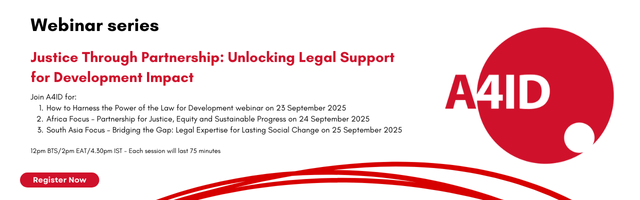
Three webinars. One shared mission: advancing human rights and sustainable development through the power of law.
From Tuesday 23 September to Thursday 25 September, A4ID’s 2025 webinar series convened NGOs, social enterprises, and legal professionals to explore how collaboration and pro bono legal support can help drive impact in an increasingly resource-constrained environment.
Across the three sessions, participants examined practical ways to strengthen human rights and development outcomes — while showcasing A4ID-facilitated pro bono partnerships that have enabled NGOs and development organisations to overcome legal barriers, unlock opportunities, and scale their impact.
The series reinforced the growing importance of pro bono legal expertise as a vital resource for the development sector, both now and in the years ahead.
Sessions included:
How to Harness the Power of the Law for Development
Partnerships for Justice, Equity, and Sustainable Progress in Africa
Bridging the Gap: Legal Expertise for Lasting Social Change in South Asia
Each discussion brought together expert insight, practical strategies, and lived experience — demonstrating how legal expertise can help create lasting, meaningful change where it is needed most.
How to Harness the Power of Law for Development
The suspension of USAID funding has triggered a crisis across NGOs and humanitarian agencies, leading to service suspensions, program closures, and job losses. This first webinar in A4ID 2025 series brought together the international development and legal sectors – two lifelines for vulnerable populations – to explore how, united, they can provide meaningful and sustainable support in this new resource constrained environment.
Speakers included: Jim Fitzgerald – Director of Equal Rights Trust Jean Scrimgeour – Co-CEO and Chief Innovation and Operations Officer at Accountability Law Constantin Fladerer-Burgess – Head of Legal at REEEP James Aiken A4ID – Pro Bono Legal Services Lead
Partnership for Justice, Equity and Sustainable Progress in Africa
The webinar highlighted the pivotal role that lawyers play in ensuring accountability, promoting responsible business, and expanding access to justice. Through pro bono legal assistance initiatives and strategic partnerships, the legal community can amplify impact, reduce inequalities, and foster a culture of equity and justice for all. These collaborative approaches ensure that the rule of law is not only preserved but also adapted to address emerging challenges such as climate change, human rights compliance, and sustainable economic development.
The session explored:
The role of lawyers and pro bono initiatives
Responsible business practices
Innovative approaches to access to justice
Speakers: Shirly Amayo – Reprieve Leonie Mutoni – Director of Programs at the Legal Aid Forum Rwanda Patrick Karanja – A4ID lead consultant Africa Moderator: Joseph Byomuhangyi – Ugandan legal and policy expert
Bridging the Gap: Legal Expertise for Lasting Social Change in South Asia
South Asia holds a crucial role in achieving the Sustainable Development Goals (SDGs), given its diverse population, economic potential, and unique social challenges. In this session, A4ID brings together partners to explore the challenges, as well as opportunities and highlight the vital role of legal professionals in addressing social challenges and driving sustainable development across South Asia.
The session explored:
The role of lawyers and pro bono initiatives
Innovative approaches and legal solutions
A4ID-facilitated pro bono projects that demonstrate pro bono as a critical resource.
Speakers: CP Shruthi – The Square Circle Clinic Lakshmi Bhatia – Women in Value Chains Network Umer Aiman Khan – Legal Circle Vishavjeet Chaudhary – A4ID South Asia Lead Consultant
Moderator Govind Manoharan – LAWASIA Human Rights Committee
CEO Insight: Building for the Long Term
In a world that increasingly values immediacy, visibility, and quick results, it is easy to focus on what can be measured in the short term. Headlines, outputs, and rapid wins all have their place. They help to build momentum, demonstrate activity, and reassure stakeholders that progress is being made. But much of the work we do, particularly in strengthening the rule of law, supporting institutions, and building legal capacity, does not lend itself to instant results. It is, by its very nature, long-term, often complex, and sometimes quietly transformative.
This is the work that happens behind the scenes. It is the careful building of relationships over time, often in environments where trust must be earned rather than assumed. It is the steady strengthening of systems that may have been under-resourced or under strain for many years. It is the investment in people, legal professionals, judges, civil society actors, who will carry this work forward long after individual programmes have concluded. It is not always visible, and it does not always produce immediate recognition. But it is essential.
At A4ID – Advocates for International Development, this long-term approach sits at the heart of everything we do. Our model is grounded in the belief that sustainable development and the realisation of human rights depend on strong legal systems, and that those systems are built not through isolated interventions, but through sustained partnership, knowledge sharing, and capacity strengthening.
Through our global network of legal experts and our partnerships with institutions and organisations around the world, we are able to contribute in ways that are both practical and enduring. This often means working alongside those closest to the issues, supporting them to navigate complex legal challenges, providing technical expertise where it is most needed, and helping to strengthen the frameworks within which they operate.
We see this reflected across a wide range of our work.
In our climate and environmental work, for example, we support partners to navigate increasingly complex regulatory landscapes, helping to strengthen the legal underpinnings of sustainable development. This includes contributing to the development of legal frameworks that enable responsible investment, support climate resilience, and ensure that environmental protections are not only articulated but enforceable.
In the area of business and human rights, our work often focuses on bridging the gap between global standards and local implementation. By supporting both legal practitioners and institutions, we help to ensure that principles are translated into practice, whether through strengthening due diligence frameworks, supporting policy development, or enabling access to justice for affected communities.
Our role in supporting access to justice more broadly also reflects this long-term approach. In many contexts, the barriers to justice are not simply legal, but structural ranging from limited capacity within institutions to lack of awareness or resources among those seeking redress. Addressing these challenges requires sustained engagement, working across systems, and building capability over time.
We also continue to see the importance of this approach in our convening power. By bringing together legal experts, practitioners, and stakeholders across sectors and geographies, we create spaces for knowledge exchange and collaboration that can lead to more coherent and effective responses to complex challenges. These connections, often formed quietly and developed over time, can have far-reaching impact.
Alongside this, our work supporting legal capacity in contexts affected by conflict and instability continues to demonstrate the importance of patience and persistence. Supporting legal actors to engage with issues such as accountability, governance, and institutional resilience is not a short-term endeavour. It requires trust, consistency, and a deep respect for context.
These examples differ in focus, but they share a common thread: meaningful and lasting change is built over time. It is rarely linear. It often involves setbacks as well as progress. And it depends on the strength of the relationships that underpin it.
This is not always easy. Long-term work requires patience, discipline, and a willingness to hold our course even when the results are not immediately apparent. It requires us to resist the pressure to prioritise what is most visible over what is most valuable. It also requires trust, trust in our partners, in our approach, and in the collective expertise that underpins everything we do.
At times, the pace of external change can feel at odds with the depth of change we are seeking to achieve. We operate in a global context marked by uncertainty, shifting political landscapes, and increasing pressure on the rule of law. In such an environment, the temptation can be to respond reactively, to focus on immediate challenges at the expense of longer-term goals. While responsiveness is important, it must be balanced with a clear sense of purpose and a commitment to the deeper, structural work that enables sustainable progress.
By investing in the foundations, strong institutions, capable legal professionals, and resilient systems, we are helping to ensure that change, when it comes, is not only possible but sustainable. This is the work that endures beyond individual projects and funding cycles. It is the work that creates the conditions for justice to be realised more consistently and more equitably.
There is also an important human dimension to this work. Building for the long term is, ultimately, about people. It is about supporting individuals to develop their skills, confidence, and leadership. It is about creating environments where expertise can flourish and where diverse perspectives are valued. And it is about recognising that lasting change is carried forward by those who are empowered to lead within their own contexts.
Internally, this perspective also shapes how we think about our own organisation. As we continue to grow, take on new programmes, and adapt to an evolving external environment, we must do so thoughtfully. This means being clear about where we can add the greatest value, being disciplined in how we allocate our resources, and ensuring that we remain true to our mission and values. It also means investing in our people, supporting our teams, listening to their experiences, and creating the conditions in which they can do their best work.
Importantly, it means being comfortable with the fact that not all impact will be immediately visible. Some of the most important outcomes of our work will only become apparent over time, sometimes long after the initial intervention has taken place. This requires a degree of humility, but also confidence in the approach we have chosen.
This moment in the year is also an opportunity to look ahead. As we continue to respond to immediate needs and emerging challenges, we do so with a clear sense of purpose. We are not only addressing what is urgent but also contributing to what is enduring.
The quiet work matters. The incremental progress matters. The relationships we build, the capacity we strengthen, and the systems we support all contribute to a foundation upon which lasting change can be realised.
Thank you to everyone, colleagues, partners, and members of our global network, who continues to contribute to this work with such commitment, professionalism, and care. It is not always the most visible work, and it is not always the easiest. But it is, without doubt, some of the most important.
Continuing the Legacy of LAP: A4ID to Support and Develop LCS and JLAP Programmes
We are pleased to announce that Advocates for International Development (A4ID) will be taking forward two outstanding initiatives, Legal Confidence Sessions (LCS) and Junior Lawyers Against Poverty (JLAP), following the planned closure of Lawyers Against Poverty (LAP).
LAP has built something truly special. Through LCS and JLAP, it has inspired young lawyers, legal professionals and students, strengthened legal capability, and championed access to justice with energy, creativity and purpose. These programmes have empowered participants with the confidence, skills and values needed to use the law as a force for positive change.
As LAP prepares for an orderly closure, we intend to provide a new home for these initiatives. At A4ID, we are closely aligned with their mission, harnessing the power of the law to tackle inequality and support sustainable development.
We are committed not only to preserving the integrity and impact of LCS and JLAP, but to investing in their growth so they can reach even more people in the years ahead. We pay tribute to the trustees, volunteers, and members of LAP whose dedication has brought these programmes to life over the past 11 years. Your work has made a tangible difference, and we are keen to continue that legacy.
We look forward to welcoming the LCS and JLAP communities into A4ID and to building the next chapter together. The mission continues, and we are enthusiastic about what lies ahead.
For more information about LAP programmes email: Info@a4id.org
Twenty Years of A4ID: Law, Power and the Pursuit of Justice
This year marks two decades since Advocates for International Development (A4ID) was founded. Anniversaries are often moments of celebration or nostalgia. For A4ID, this milestone demands something more serious: a clear-eyed reflection on the role of law in development, the power it holds to shape lives, and the responsibility that comes with deploying it in contexts shaped by inequality, fragility and conflict.
Twenty years on, the question is not simply what A4ID has achieved, but whether the global development system has truly learned the lesson that law is not optional.
A4ID was established in response to a persistent blind spot in development thinking. Two decades ago, law was frequently treated as peripheral, a technical or transactional concern to be addressed late in the process, or only when programmes encountered difficulty, in other words when things went wrong. Legal frameworks, institutions and incentives were too often an afterthought.
Experience has since shown what many communities already knew. Development efforts that fail to engage seriously with the law are inherently fragile. Without the rule of law, gains cannot be sustained. Without legal accountability, progress remains precarious. Without access to justice, those most affected by poverty and exclusion remain unheard.
But there is a further reality that must be acknowledged: law is not neutral. When poorly designed or irresponsibly applied, it can entrench inequality, legitimise exclusion and reinforce the very power imbalances development seeks to address. This is why the question has never simply been whether to engage the law, but how, for whom, and to what end.
From the outset, A4ID set out to challenge both the marginalisation of law in development and its uncritical use.
Our proposition was never that law alone could resolve deeply entrenched challenges. It was, and remains, that development initiatives which ignore the law are destined to fail, and that those which deploy it without humility risk doing harm. When legal expertise is mobilised responsibly, in partnership with those closest to the problem, it can shift power, protect rights and strengthen systems in ways that endure long after individual projects end.
Over the past twenty years, A4ID has worked across continents and sectors, supporting civil society organisations, governments, judiciaries and international institutions to confront some of the most complex challenges of our time. From strengthening regulatory frameworks and tackling corruption, to advancing women’s economic participation, safeguarding vulnerable communities and supporting accountability for international crimes, the breadth of our work reflects both the versatility of law and the depth of global need.
Critically, our impact has never been about imposing external solutions. A4ID’s model is grounded in partnership and humility. We exist to support, not supplant; to connect world-class legal expertise with locally led priorities; and to ensure that pro bono support is ethical, strategic and anchored in real-world impact. This approach has enabled us to work effectively in environments where legal infrastructure is weak, contested or emerging and where the consequences of failure are borne by those with the least power.
Some of A4ID’s most significant outcomes are not immediately visible. They are found in institutions that are stronger than before; in legal precedents quietly established; in capacity that is built and retained; and in systems that are more resilient over time. They are seen when communities are better protected from exploitation, when women gain enforceable rights in new sectors of the economy, or when accountability mechanisms begin to take shape for the gravest crimes under international law.
The demand for credible, independent legal capacity, rooted in local realities yet connected to global expertise, has never been greater. Whether supporting accountability for war crimes, strengthening regulatory frameworks in emerging economies, or ensuring that development initiatives are legally sound and rights-respecting, A4ID operates at a critical intersection between law, power and justice.
At its core, A4ID’s work has always been about political economy.
Legal systems do not operate in a vacuum. They reflect power relations, economic interests and political incentives. In many of the contexts where we work, the law is not simply underdeveloped; it is actively shaped by those who benefit from opacity, exclusion and weak accountability. Too often, development succeeds on paper while failing in practice because it leaves existing power structures untouched.
Over the past two decades, A4ID has worked precisely at this intersection where law meets power. We have seen how legal frameworks can be weaponised to exclude, how regulatory gaps enable exploitation, and how weak enforcement renders rights meaningless in practice. Equally, we have seen how carefully targeted legal interventions can disrupt entrenched interests, rebalance power and create space for reform.
This is why legal capacity building is never a purely technical exercise. It is inherently political. Supporting independent judiciaries, strengthening regulatory regimes or enabling civil society to use the law effectively all involve navigating contested terrain. They require credibility, trust and contextual understanding, as well as the discipline to resist short-term wins in favour of long-term systemic change.
The global context has only intensified these dynamics. Democratic backsliding, shrinking civic space, the rise of authoritarian governance and the increasing concentration of economic power are placing extraordinary pressure on the rule of law. At the same time, global crises, from climate change to armed conflict, are exposing the fragility of legal systems that were never designed to withstand such shocks.
In this environment, A4ID’s role is both pragmatic and principled. We help partners navigate complexity, strengthen institutions from within, and ensure that legal solutions are not only technically sound but politically viable. We recognise that sustainable change requires engaging with incentives as well as ideals and that law can only deliver justice when it is embedded in systems people trust and can access.
This is not easy work. It is slow, contested and often uncomfortable. But it is precisely this work that determines whether development gains endure or unravel when political winds shift.
The next chapter will demand boldness as well as rigour. It will require stronger collaboration across sectors, greater investment in local legal capacity, and a persistent willingness to engage with the realities of power and politics. It will also require continued humility recognising that the law can only serve justice when it is accessible, trusted and shaped by those it is meant to protect.
None of this has been achieved alone. A4ID’s strength has been its people and its partnerships: the lawyers who have given their expertise pro bono with integrity and purpose; the development partners who have recognised the value of legal insight; the trustees who have guided the organisation with care; and the staff who work, often behind the scenes, to ensure that our interventions are thoughtful, effective and impactful. Above all, our work has been guided by the trust of the communities and institutions we support, a responsibility we do not take lightly.
Twenty years on, A4ID remains committed to its founding belief: that the law can be a powerful force for good but only when it is applied with a sense of moral purpose, accountability and a resolute focus on justice.
This anniversary is not a conclusion. It is a reaffirmation of purpose and a call to responsibility.
We are living through a period of profound global instability. Armed conflict, climate change, democratic erosion and widening inequality are placing unprecedented strain on legal systems worldwide. At the same time, the rule of law itself is increasingly contested, weakened by political interference, under-resourced institutions and, in some cases, deliberate dismantling.
In this environment, the work A4ID does is not optional; it is essential.
The challenges ahead are formidable. But if the past twenty years have taught us anything, it is that when legal expertise is mobilised thoughtfully, collaboratively and ethically, it has the power not only to change lives, but to reshape systems and, in doing so, help build a more just world.
Our work continues…
CEO Insight: Shaping the Future of Pro Bono Together
Imagine a world where pro bono becomes the norm, not the exception.
Two-thirds of the world’s population have justice issues – whether access to justice, excluded from the opportunities the law provides, or those who live in extreme conditions of injustice. Pro bono legal work is essential for promoting access to justice and addressing systemic inequality. And fulfilling the ethical responsibilities of lawyers and the legal sector.
An estimated 253 million people live in extreme conditions of injustice. They are among the most disconnected from the protections of law and the promise of justice, yet it is precisely here that the world’s commitment to fairness and human dignity is most urgently tested.
We are, I believe, on the cusp of a new era, ushered in by technology and necessitated by the complex, interconnected and urgent challenges facing our world. We are approaching at time when outcomes will matter as much as intention and when pro bono is not restricted to legal actors but across sectors.
A few months into my sabbatical, I encountered something unexpectedly rare: silence. The kind of quiet that interrupts the rhythm of constant decision-making, problem-solving, and the day-to-day responsibility of leading an organisation. It was in that stillness that I realised something – that I had not been paying enough attention to the world beyond our immediate work.
During my time as CEO of A4ID, I have worked alongside a team whose commitment, talent, and decency have shaped an organisation that matters. Our work is real, and its impact is tangible. But stepping away from the usual demands of leadership, I understood something else: my role is not only to safeguard what we have built.
It is to imagine what comes next and to give that vision voice. To speak about it often. And to speak about it outwardly.
The pro bono moment we are in
The next decade will transform pro bono work, not gradually, but at a pace. We are at an inflection point where technology is dissolving traditional barriers to accessing legal expertise and opening doors for those who need advice most.
Tools that once seemed revolutionary are now part of everyday practice. Document collaboration platforms, for example, have streamlined the complex and often paper-heavy world of legal work. In fields such as personal injury law, where vast amounts of evidence must be shared and reviewed, these tools enable lawyers and volunteers to work together efficiently across time zones and organisations.
Artificial intelligence is also making waves in the pro bono space. AI-assisted triage forms and referral systems allow teams to handle large volumes of enquiries quickly and professionally, offering tailored guidance to each client who reaches out. Yet, while the technology helps to scale services and reduce waiting times, it remains just a tool. The human judgment, empathy, and ethical discernment of legal professionals still underpin every decision.
As innovation accelerates, the challenge and opportunity are to use technology to enhance, not replace, the human touch, amplifying the reach and impact of pro bono work with greater speed and care.
Consequently, we are moving from broad notions of “doing good” to legitimate, measurable impact. A new generation of professionals across law, technology, engineering, finance and design sees pro bono not as an optional act of generosity but as integral to who they are and the careers they want to shape.
Meanwhile, the challenges facing our world have grown more complex, more interconnected, and more urgent. We cannot afford half-measures.
Here is the future I believe we will see: By 2035, contributing skilled time to social good will sit alongside professional development as a core expectation. Young professionals will not ask, “Should I contribute?” but rather, “Where is my contribution needed?”
The stigma of time-giving will be gone; in its place will stand a culture of recognition, expectation, and genuine pride. Pro bono will become the norm, not the exception.
The expertise gap will close
Today, organisations with the most urgent needs often have the least ability to access support. Around 1.5 billion people are still unable to find justice when they need it most. They are victims of crime, or individuals seeking to resolve everyday civil and administrative matters, yet too often they encounter barriers that prevent fair outcomes. Many live in countries with functioning institutions and justice systems, but the doors of justice remain partly closed because of cost or lack of support.
That will change decisively as geography will become irrelevant. Digitally enabled platforms and AI-supported matching will enable a rights-based organisation in rural Nigeria to work in real time with a pro bono team in London or Singapore, with minimal friction.
Impact will be the only currency that counts. We are entering an era in which outcomes will matter as much as intentions. We are tired of vague stories about “making a difference.” The next decade will demand proof. Not because we are cynical, but because we are serious.
The organisations leading this charge will have sophisticated tools to track outcomes and show how legal advice scaled a social enterprise or how strategic consulting helped a nonprofit triple its reach. Data and storytelling will merge.
Pro bono will attract not just lawyers but also engineers working on climate adaptation. Not just consultants, but data scientists shaping ethical AI and strategists strengthening governance. Retirees, students, and mid-career professionals seeking meaning and purpose. We will see a richer, more diverse, and more capable ecosystem of talent than ever before.
Purpose-driven networks will become powerful institutions
At present, pro bono work exists in countless dedicated but often disconnected initiatives around the world. While each project makes a noticeable difference, the fundamental transformation will come as these efforts begin to connect and collaborate on a global scale. By 2035, we can expect to see the rise of international communities of practice comprising legal professionals, NGOs, and advocates who share knowledge, coordinate resources, and act with agility and purpose.
As the Solicitor General, Sarah Sackman KC MP, observed during last year’s Pro Bono Week, “The power of pro bono lies in its people. That starts with the clients.” These emerging communities will not replace traditional institutions, but will function alongside them, shaping agendas and accelerating change, credibility, and impact.
Why leaders must look outward
My sabbatical reminded me of something essential but simple: the future will not arrive on its own. It requires leaders who are willing to look outward, to articulate what’s possible, and to build the alliances that make it real.
For years, I’ve been the leader who has focused on internal aspects, such as ensuring stability, navigating risk, and strengthening teams. All of it necessary; none of it wasted. But insufficient for the moment before us.
The next phase of leadership, mine included, requires a different posture. Not performative visibility, but genuine engagement. An openness to dialogue with funders, policymakers, practitioners, and the public. A willingness to challenge assumptions, name what is not working, and make the case for why pro bono will be central to driving change in a world that desperately needs it.
It is not about grandstanding. It is about presence and responsibility.
The team that makes it possible
I want to pause here to acknowledge something fundamental: none of these reflections, and none of this vision, exists in isolation. It comes from the team at A4ID. My team operates from a place of care, for each other, for the organisations we serve, for the vision of pro bono work itself. My team thinks critically, challenges constructively, and is a constant reminder that any future we imagine must work for real people, not just rely on elegant theories.
Leadership, as we know, is never solitary. It is always shaped and strengthened by the people around you, by the conversations you have and by the experiences you share. The future of pro bono will be built not by individuals, but by teams of people who choose every day to bring rigour, compassion, and creativity to work that matters.
What this means now
If we can clearly see where pro bono is heading, our responsibilities today come sharply into focus. The next chapter will be written by those willing to experiment without fear, to build the systems that scale impact, and to connect ideas and people across disciplines, institutions, and borders.
We must tell the stories of what works, boldly and often, to share and strengthen innovation, courage, and compassion. We must invest in people: not just through resources, but through trust, mentorship, and belief in their potential to lead change. And above all, we must resist the comfort of staying within our own organisational boundaries. Now is the moment to step out, speak up, engage, debate, explain and persuade.
The future of pro bono will not unfold by chance. It will take shape through the choices we make and the leadership we exercise today, not tomorrow. Its brightness depends on our willingness to imagine more and to act decisively in the service of justice. Together, we can ensure that this future is not only possible but inevitable.
The Power of Partnership during India Pro Bono Week 2025
Across India, many civil society organisations continue to face barriers when accessing the legal support, they need to deliver their work effectively. From organisational set-up and governance to regulatory compliance and programme delivery, legal challenges can slow progress and limit impact.
India Pro Bono Week, held from 24–28 November 2025 under the theme Growing Access to Pro Bono, shone a spotlight on these challenges and the role that pro bono legal support can play in helping organisations overcome them. Through a series of discussions and events, co-organisers Advocates for International Development (A4ID) and TrustLaw brought together lawyers, students, NGOs and development practitioners to share experiences and explore how legal expertise can strengthen communities and advance sustainable development.
One of the week’s greatest strengths was the diversity of voices involved. Participants from across the legal and development sectors reflected on the opportunities created by pro bono support, as well as the barriers that remain when legal assistance is out of reach.
CEO of A4ID, Yasmin Batliwala MBE Hons LLD, reinforced the necessity of pro bono in bridging the gap between vulnerable populations and legal resources in a nation of 1.4 billion people: “Pro bono is part of what we do and what it means to be a just society. It’s a bridge between those who have access to the law and those who do not.”
A key theme throughout the week was the importance of embedding a culture of pro bono early in legal careers. Speakers highlighted the role of university legal clinics in providing students with practical experience while supporting individuals and organisations that may otherwise struggle to access legal advice. These initiatives not only expand access to justice but also encourage future lawyers to view pro bono work as an integral part of professional practice.
Prof. Anup Surendranath, of NALSAR & Project 39A, delivered a powerful address on the transformative potential of legal aid in India’s justice ecosystem and challenged the academic community to shift from seeing legal aid as an educational tool to recognising it as a fundamental constitutional and social responsibility. “Law schools can no longer view access to justice as something that they do for their students to learn. Rather, I think it is an obligation to fill the access to justice gap that exists in societies like ours,” he told the Plenary session audience.
Across the week the impact of legal support was brought to life through the experiences of development organisations. During a session on the Business Case for Pro Bono, environmental organisation Plant-for-the-Planet shared how pro bono assistance was helping them establish an Indian entity, enabling their action and youth education programmes to expand. Prem Raval, of Plant-for-the-Planet, explained how with expert legal guidance, a complex process became more manageable, allowing the organisation to move forward with greater confidence and focus on its mission. He told the session: “I personally believe that what A4ID is doing is not just legal support but it’s strategic in nature – it’s not just charity; it’s strategy,” He added that the value that will created would be exponential.
Law firms also reflected on the value of pro bono work within their own organisations. Beyond supporting communities, pro bono opportunities help lawyers develop new skills, deepen their understanding of social and environmental challenges, and strengthen engagement across teams.
Aruneshwar Gupta, Senior Advocate, India, highlighted that young lawyers are increasingly driven by purpose. He said: “A credible pro bono program signals that the law firm stands for justice and not only for profit. It builds loyalty, reduces burnout, and deepens a sense of professional pride,” adding “reputation is not just about winning cases, but about what you stand for and who you stand with.”
India Pro Bono Week reinforced a simple but powerful message: meaningful change happens through partnership. By bringing together legal expertise and development organisations, pro bono support can help remove barriers, strengthen civil society and enable organisations to maximise their impact.
A4ID remains committed to expanding access to pro bono legal support and connecting organisations with the expertise they need to achieve their goals. Together with partners across the legal and development sectors, we will continue working to ensure that legal support is available to those driving positive change.
Learn more about A4ID’s Legal Pro Bono work or ROLE UK programme and how to get involved.
Catch up on all the sessions here and look out for updates of India Pro Bono Week 2026.
India Pro Bono Week 2025
India Pro Bono Week, held from 24–28 November 2025 under the theme Growing Access to Pro Bono, shone a spotlight on challenges India faces and the role that pro bono legal support can play in helping organisations overcome them.
Through a series of discussions and events, organisers A4ID and TrustLaw brought together lawyers, students, NGOs and development practitioners to share experiences and explore how legal expertise can strengthen communities and advance sustainable development.
Inaugural Plenary: Defining Pro Bono and the Role of University Legal Aid
The opening session of India Pro Bono Week 2025 brought together leaders from across the legal, academic and development sectors to explore how pro bono legal services can strengthen access to justice and support more inclusive legal systems in India. Framed around the theme of expanding access to pro bono, the discussion examined the role of lawyers, law schools, civil society organisations and community advocates in creating a more coordinated and sustainable pro bono culture.
Speakers highlighted the need to move beyond fragmented approaches to legal assistance and build stronger pathways between legal expertise and the communities most in need of support. Contributions from TrustLaw, A4ID and other sector leaders reinforced the idea that pro bono is not simply charitable work but a strategic tool for advancing the public good, strengthening institutions and contributing to the achievement of the Sustainable Development Goals (SDGs).
A keynote address from Professor Anup Surendranath, of NALSAR, further challenged law schools to view clinical legal education as an integral part of the justice delivery system, with a responsibility to serve communities as well as educate future lawyers.
The panel discussion focused on the practical realities of expanding access to justice, highlighting the crucial role played by paralegals, community organisations and grassroots networks in helping individuals navigate the legal system.
Speakers also addressed the importance of creating sustainable pathways for lawyers to engage in pro bono work, particularly for young and first-generation practitioners who often face financial and professional barriers to public interest practice.
The session concluded with a call to action from A4ID’s CEO Yasmin Batliwala MBE Hons LLD for the legal community to work collectively towards a future where access to justice is not a privilege but a fundamental right available to all.
The Impact of Pro Bono: Lesson and Stories from A4ID’s Global Case Studies
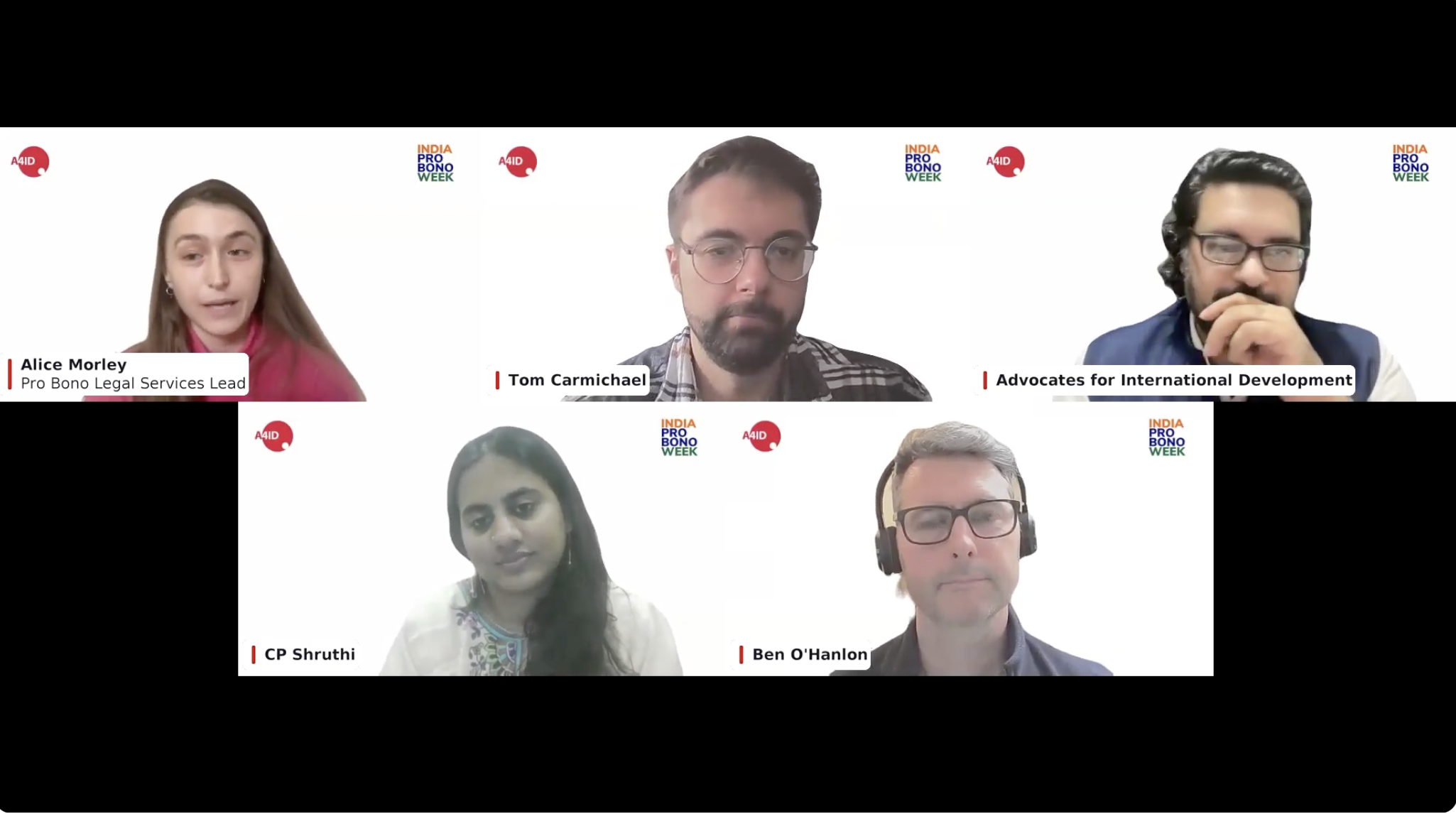
As part of India Pro Bono Week 2025 A4ID held a session exploring pro bono in practice. The session brought together legal practitioners and development experts to explore the transformative role of pro bono legal services in advancing social justice and the UN Sustainable Development Goals (SDGs).
The discussion highlighted A4ID’s unique role as a bridge between legal professionals and organisations working to combat poverty and inequality through its Pro Bono Legal Services (PBLS) brokerage model. By managing both short-term advisory matters and long-term strategic projects, A4ID ensures that pro bono engagements are delivered with the same level of professionalism, accountability and quality as commercial legal work.
The session showcased the tangible impact of pro bono legal support through a series of real-world examples. Pro Bono Legal Officer Tom Carmichael shared how legal advice helped a South African education non-profit avoid costly litigation and how strategic legal assistance enabled environmental charity JUST ONE Tree to revise its deed of gift, creating greater flexibility in its funding model.
The panel also examined A4ID’s Rule of Law (ROL) programme, which supports long-term legal and institutional strengthening initiatives in ODA-eligible countries, including legislative review, capacity building and projects addressing issues such as illegal wildlife trade. These examples demonstrated how targeted legal expertise can help organisations increase their effectiveness and expand their social impact.
A further focus of the discussion was the role of pro bono work in strengthening access to justice. CP Shruthi, from the Square Circle Clinic, outlined its efforts to improve fairness in Indian capital punishment cases through mitigation practice, combining forensic investigation, mental health support and specialist training for social scientists.
The panel also reflected on the evolving culture of pro bono practice, noting its established presence in the UK and US and its growing momentum in India. While challenges remain—including financial pressures on early-career lawyers, infrastructure limitations and the integration of pro bono work into traditional law firm structures—speakers emphasised the significant professional and social value of participation.
Pro bono work not only provides lawyers with exposure to innovative and complex matters but also enables them to contribute meaningfully to global development, human rights and sustainable change.
Why do legal pro bono? The Business Case for Pro Bono: Strategic Value for Indian Law Firms
As part of week, A4ID also convened legal and development sector leaders to examine the growing business case for pro bono legal practice in India. The discussion explored how pro bono work creates value not only for non-profit organisations seeking specialist legal support, but also for law firms looking to strengthen talent development, enhance reputation and respond to increasing client expectations around ESG and social impact.
Speakers highlighted how strategic legal support can help organisations overcome regulatory challenges and scale their work, with Prem Raval, of Plant-for-the-Planet, describing A4ID’s support as “not just legal support but strategic in nature.” The panel also examined the professional benefits of pro bono engagement, with Sunita Bhambri noting that lawyers’ skills are uniquely positioned to help organisations drive meaningful change while providing valuable opportunities for learning and career development.
The session concluded by exploring the wider business benefits of pro bono, including talent retention, training, brand reputation and risk management. Speakers also discussed emerging approaches to measuring social impact through a proposed Pro Bono Social Impact Credit System, reinforcing the view that pro bono is increasingly becoming an integral part of modern legal practice rather than a purely charitable endeavour.
If you are a Civil Society Organisation or NGO find out how A4ID can help with Legal Pro Bono or explore our ROLE UK Programme to learn more about our rule of law work.
Join us for India Pro Bono Week 2026 in November. More details to follow.